NukeWorker Menu

Employers

Employer Login Help & FAQ Prices Testimonials Info Kit Resume Summary Post Jobs Search Resumes Employer Register

Job Seekers

Jobseeker Login Post Resume Search Jobs Job Seeker Register

Advertising

Banner Ads Lodging Post Jobs Info Kit

Other Services

Outage Schedules Gold Member Study Guides Upload Picture View Pictures Calendar Quiz Help Search for User

Nuclear Pictures

NukeWorker online photo album.

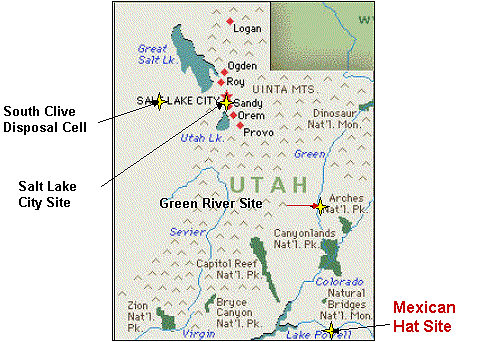
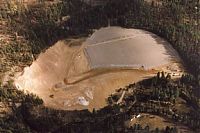
The former Mexican Hat uranium mill site is located on Navajo Nation land 1.5 miles southwest of Mexican Hat, San Juan County, Utah. The site is northeast of the town of Halchita, Utah, which began as the housing area for the mill's employees.
Radioactive mineral deposits in the Triassic rocks of the Colorado Plateau area of Utah were first worked during the early 1900s. In 1912, a high grade vanadium-uranium deposit was mined in the Temple Mountain area of Emery County, Utah. During World War I, high grade uranium ore was mined for radium from deposits in the Chinle Formation (Moss Back Member) at Temple Mountain. Over the period 1920-1940, the U.S. Geological Survey conducted a field reconnaissance and mapping project to evaluate the oil and gas potential in a broad area of eastern Utah and northeastern Arizona. In that study, uranium, vanadium, and copper minerals in Triassic rocks were noted in many places throughout the region, especially near the unconformable contact between the Moenkopi Formation (Early and Middle(?) Triassic age) and the Chinle Formation (Late Triassic age).
Keywords: Mexican Hat UMTRA

The former Mexican Hat uranium mill site is located on Navajo Nation land 1.5 miles southwest of Mexican Hat, San Juan County, Utah. The site is northeast of the town of Halchita, Utah, which began as the housing area for the mill's employees.

Radioactive mineral deposits in the Triassic rocks of the Colorado Plateau area of Utah were first worked during the early 1900s. In 1912, a high grade vanadium-uranium deposit was mined in the Temple Mountain area of Emery County, Utah. During World War I, high grade uranium ore was mined for radium from deposits in the Chinle Formation (Moss Back Member) at Temple Mountain. Over the period 1920-1940, the U.S. Geological Survey conducted a field reconnaissance and mapping project to evaluate the oil and gas potential in a broad area of eastern Utah and northeastern Arizona. In that study, uranium, vanadium, and copper minerals in Triassic rocks were noted in many places throughout the region, especially near the unconformable contact between the Moenkopi Formation (Early and Middle(?) Triassic age) and the Chinle Formation (Late Triassic age).

maybell~0.gif naturita.gif mexicanhat.gif maybell.gif 2002726.jpg
File information
Filename:mexicanhat.gif
Album name:Rennhack / Mexican Hat Mill
Keywords:Mexican / Hat / UMTRA
Filesize:43 KiB
Date added:Jan 24, 2006
Dimensions:478 x 342 pixels
Displayed:2347 times
URL:https://www.nukeworker.com/pictures/displayimage.php?pid=4592
Favorites:Add to Favorites